Height
20–22 in
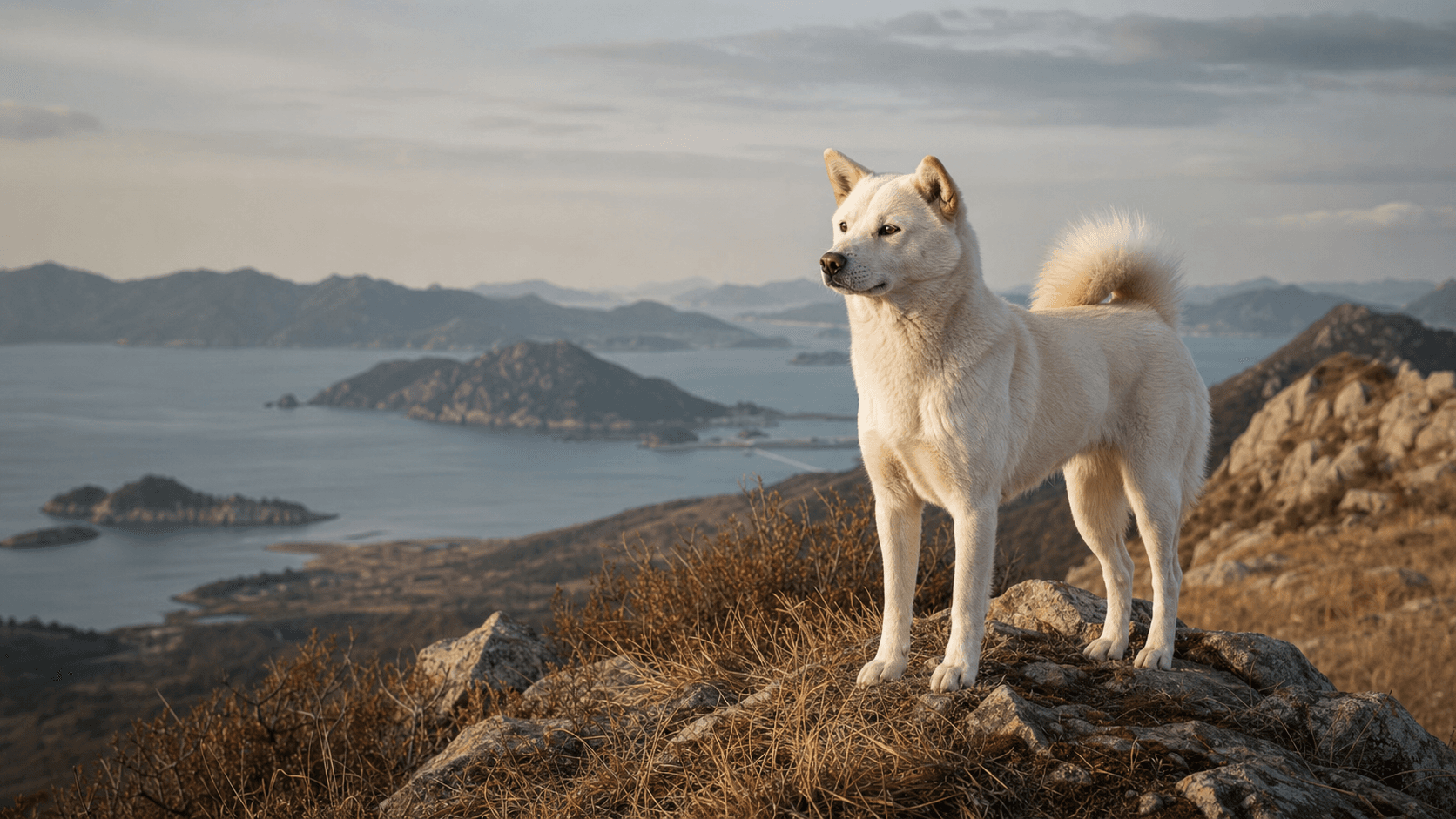
A fiercely loyal national treasure of Korea.
진돗개 · Jindo-gun, South Korea
Overview
The Korean Jindo Dog is a medium-sized hunting breed native to Jindo Island, off the southwestern coast of South Korea. Prized for loyalty so pronounced it has entered national folklore, the breed was declared South Korea's Natural Monument No. 53 in 1962.
Bred for centuries as an independent hunter of small and occasionally large game, the Jindo developed sharp senses, unusual problem-solving intelligence, and a fiercely devoted bond to one household.
Native range
The breed takes its name from a rugged island about 45 km long. Isolation from the peninsula for centuries allowed its working traits and appearance to remain largely unchanged, a heritage Korea has actively protected since the 1930s.
Physical characteristics
Height
20–22 in
Weight
40–60 lb
Build
Athletic, square
Coat
Double, dense
A wedge-shaped skull, erect triangular ears, and deep-set almond eyes give the Jindo its watchful, fox-like expression.
A thick high-set tail curls over the back or carries in a sickle—an instantly recognizable field silhouette.
Light, efficient, and quick, built for covering rugged island terrain rather than pulling or guarding by weight.
White
백구
Fawn / red
황구
Brindle
호구
Black & tan
흑구
Grey
재구
Jaw strength
170
PSI, estimated bite force
The Jindo's bite reflects its history as a versatile hunter of small and mid-sized game, generating enough pressure for a firm hold without the extreme force seen in mastiff-type guardian breeds.
Relative to other breeds
Published PSI figures vary by study and are best read as broad comparison context, not a breed-specific laboratory measurement.
From its curled tail to its dense double coat, much of the Jindo's distinctive look traces to a small set of well-studied canine genes—many shared across other primitive spitz breeds.
Inherited health risks and how they're passed down
Uncommon but reported; influenced by multiple joint-conformation genes and growth rate rather than one mutation.
Middle-age onset; linked to several immune-regulation genes rather than a single hereditary marker.
Environmental skin sensitivities with a heritable component shared across many spitz breeds.
The genetics behind the breed's signature physical traits
Spitz tail-set loci
Polygenic—spread across many genes, not mapped to one locus
Shared across spitz breeds; governs the high tail-set and tight curl rather than a single Mendelian gene.
MSRB3 region · Chromosome CFA10
Illustrative locus position, not to exact scale
Associated with the upright ear carriage seen across many primitive and spitz-type breeds.
Undercoat density loci
Polygenic—spread across many genes, not mapped to one locus
Governs the thick undercoat responsible for the breed's twice-yearly seasonal blow.
MC1R (+ ASIP) · Chromosome CFA5
Illustrative locus position, not to exact scale
MC1R interacts with ASIP to produce the Jindo's white, fawn, brindle, and black-and-tan variants.
Gallery
History & origin
Archaeological and historical records place Jindo-type dogs on the island for more than a thousand years. Left largely to develop without outside crossbreeding, they became a self-sufficient landrace suited to hunting deer, boar, and small game over rocky terrain.
Naturalists formally catalogued the breed in the 1930s. In 1962 Korea named the Jindo a Natural Monument, creating a program that registers pedigrees and once tightly restricted export.
“Baekgu,” a white Jindo who reportedly traveled roughly 300 km back to her original owner after being sold away, became a national folk story of unbreakable loyalty.
Temperament & behavior
Bonds deeply with one family or handler and may remain aloof with strangers.
Keen senses and a watchdog instinct make the breed quick to notice unfamiliar activity.
Bred to hunt without direct oversight, it problem-solves on its own terms.
Strong instincts toward small animals mean recall and management need consistent work.
Training & exercise
60+
A working hunting breed needs sustained activity, not only short walks, to settle indoors.
1:1
Training progresses best with one consistent person the dog learns to respect.
Early
Structured exposure before 16 weeks can meaningfully soften natural wariness.
Health & lifespan
12–15
Years, average lifespan
The Jindo is considered a robust breed with few genetic predispositions relative to other purebreds. Routine veterinary care and weight management address most concerns.
Uncommon but reported; responsible breeders screen breeding stock.
Occasionally seen in middle age; managed with bloodwork and medication.
Some dogs show environmental or food sensitivities, generally manageable.
Lean by nature, but excess weight still adds strain to joints.
Grooming & care
Twice yearly, the dense undercoat sheds heavily for two to three weeks; daily brushing keeps pace.
Weekly brushing throughout the rest of the year controls loose hair and distributes oils.
Jindos are often fastidious and cat-like in their grooming, with little appetite for dirt or strong odors.
Nutrition
2
Two measured meals suit the breed; free-feeding may encourage food-guarding tendencies.
1,000–1,400
An adult estimate that varies with size, health, and activity level.
Protein-forward
A complete diet that supports a lean, active build rather than a filler-heavy formula.
Sound & vocalization
Vocalization level
Moderate — alert barker
Quick to vocalize at an unfamiliar approach to the home or territory.
Rarely barks without cause once familiar with its environment.
Environmental sensitivities
Heat tolerance
Adapted to a temperate climate; still needs shade and water in peak summer.
Cold tolerance
The dense double coat gives strong cold tolerance in Korean winters.
Senior care
7–8 yrs
Many Jindos are considered senior around this age, though healthy dogs can slow later.
Joint support
Shorter, more frequent walks and veterinary guidance help manage stiffness.
Cognitive checks
Confusion or house-training regression can signal cognitive change.
Pet insurance considerations
Premium tier
Low–moderate
A generally healthy landrace breed with few chronic conditions can keep premiums modest compared with many purebreds. Costs and coverage always vary by insurer, dog, and location.
Skin allergies and orthopedic issues make up the bulk of claims.
Rarely breed-restricted by insurers, unlike some bully-type breeds.
Did you know
Jindo owners in South Korea historically needed government paperwork to export a purebred dog.
The curled tail is so characteristic that straight-tailed puppies can be disqualified from registry.
Jindos may bury or cache food, a holdover from their semi-wild hunting past.
A statue of the loyal Jindo Baekgu stands on Jindo Island.
The breed is sometimes called the Korean Shiba by newcomers, though the two developed independently.
Jindos historically hunted in pairs or small packs, including for roe deer.